
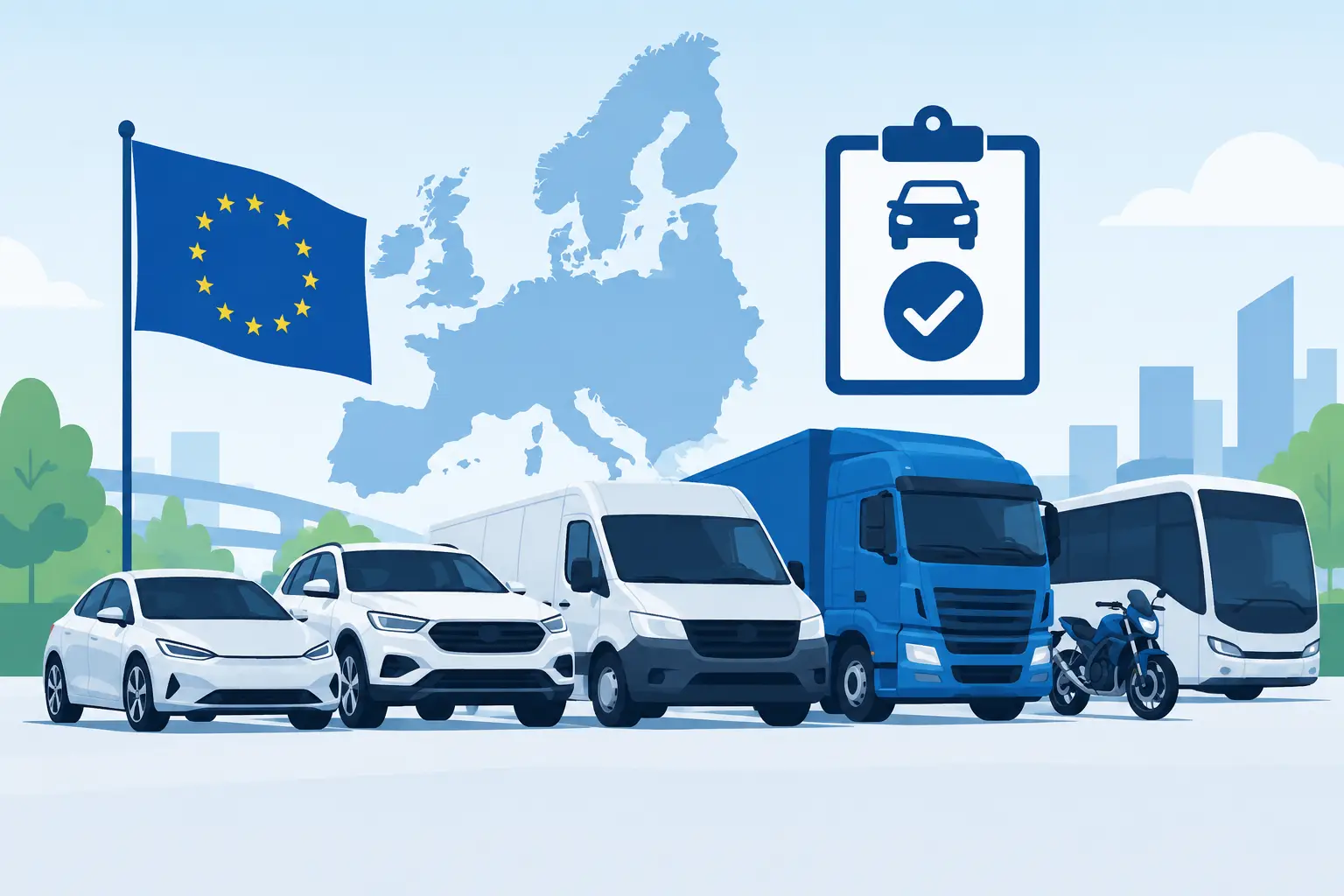
A vehicle can be perfectly legal on the road in the United States and still face a registration problem in Europe. The reason is type approval. If you are asking which vehicles need type approval, the practical answer is that nearly every new road vehicle placed on the European market needs an approved route to prove it meets EU or national technical rules.
For an owner or importer, the key question is usually not whether approval exists in theory. It is whether you have the correct evidence for the registration authority. For many EU-spec vehicles, an original manufacturer-issued Certificate of Conformity, or COC, is that evidence. For vehicles built for another market, heavily modified vehicles, or certain older models, a different approval process may be required.
What type approval means for vehicle registration
Type approval is a regulatory process that confirms a vehicle type meets applicable safety, environmental, and construction standards before it is sold or registered. Rather than testing every identical vehicle from scratch, authorities approve a defined vehicle type, variant, and version.
In the EU, this is commonly referred to as EU whole vehicle type approval. It covers the vehicle as a complete product and can include braking, lighting, emissions, noise, occupant protection, electronic systems, dimensions, and other requirements. A valid COC connects one individual vehicle, identified by its VIN, to that approved vehicle type.
This matters most when a vehicle crosses borders. Registration offices need reliable proof that the vehicle is eligible for road use under their rules. An authentic OEM COC can reduce the need for additional technical inspections when the vehicle was originally built to EU type approval.
Which vehicles need type approval?
The requirement applies primarily to vehicles intended for use on public roads. The exact route depends on the category, the vehicle’s age, where it was first placed on the market, and whether its original specification has changed.
Passenger cars and SUVs
Passenger cars, sedans, wagons, coupes, convertibles, and SUVs generally fall within category M1. New M1 vehicles sold in the EU normally require whole vehicle type approval before they enter the market.
If you are importing a used EU-spec BMW, Tesla, Toyota, Audi, Mercedes-Benz, Volkswagen, Volvo, or similar passenger vehicle into another European country, an OEM COC is often the document requested during registration. It confirms the approved technical specification, including items such as emissions standard, engine output, mass, fuel type, and CO2 data.
A U.S.-spec vehicle is different. Even if it is the same model name, its lighting, emissions equipment, speedometer markings, or other specifications may not match the European approved version. A COC may not exist for that VIN, and individual approval or modification may be necessary.
Vans, pickups, trucks, and commercial vehicles
Commercial vehicles also need an approval basis. Light vans and many pickups are commonly classified in category N1, while heavier goods vehicles fall into N2 or N3. Their approval requirements can be more complex because payload, axle weights, body construction, towing equipment, tachograph requirements, and emissions rules may all affect registration.
A factory-built van with an EU COC is usually straightforward. A converted van may not be. Adding a refrigerated body, tipper bed, wheelchair lift, cargo shelving, or other equipment can change the vehicle classification or technical data. The registration authority may ask for additional documents from the converter, an updated approval record, or an inspection.
For fleet managers and dealerships, this distinction is crucial. Do not assume that a base-vehicle COC automatically covers every conversion completed after production.
Motorcycles, scooters, and mopeds
Motorcycles, scooters, mopeds, tricycles, and quadricycles are also subject to type approval rules. These vehicles are generally grouped under the L category. A COC is commonly used to support registration of an EU-market motorcycle or scooter imported from another member state.
Engine swaps, aftermarket exhaust systems, altered frames, non-approved lighting, and significant performance modifications can create problems. The original approval applies to the vehicle as manufactured. If the vehicle no longer matches that approved configuration, the authority may require inspection or individual approval before registration.
Trailers, caravans, and motorhomes
Trailers and caravans generally fall under category O, while motorhomes may be based on passenger or commercial vehicle categories depending on their construction. New factory-built caravans and trailers intended for EU sale normally need type approval, and an original COC can be central to cross-border registration.
Motorhomes deserve extra attention. A factory-produced motorhome may have complete approval documentation. A camper conversion built from a cargo van, however, can require a separate approval process. Changes to seating, windows, gas installations, electrical systems, weight distribution, and sleeping facilities may all be relevant.
Buses and special-purpose vehicles
Buses, coaches, ambulances, hearses, wheelchair-accessible vehicles, and other special-purpose vehicles also require an approval pathway. These vehicles often have additional compliance requirements because their design affects passenger safety, emergency access, seating, restraint systems, or operational use.
The original vehicle manufacturer’s COC remains valuable, but it may need to be paired with documentation from the body builder or conversion company. Approval is not always a single document when several manufacturers contributed to the final vehicle.
When a COC is enough and when it is not
An OEM Certificate of Conformity is usually enough when the vehicle meets four conditions: it was built for the EU market, it has an EU whole vehicle type approval number, it remains in its original approved specification, and the receiving country accepts the COC for the intended registration process.
That is the common situation for a standard used car moving between EU countries. The registration office can use the certificate to enter technical data accurately and verify conformity without asking you to obtain manufacturer confirmation from scratch.
A COC is not a universal substitute for approval. It may not solve the problem if the vehicle was manufactured for the U.S., Canadian, Japanese, Gulf, or another non-EU market. It may also be insufficient for a vehicle with major modifications, a custom build, a rebuilt salvage vehicle, or a vehicle lacking an EU approval number.
In those cases, the authority may require individual vehicle approval. This is an assessment of the specific vehicle rather than a pre-approved production type. It can involve inspections, measurements, proof of component compliance, technical reports, and required changes before registration is granted.
Older vehicles and classic cars
Older vehicles are not automatically exempt from registration requirements, but their route is often different. A classic car may predate modern EU whole vehicle type approval or have been registered under historical national rules. Registration authorities may use age-based exemptions, national historic vehicle procedures, or individual assessment.
The trade-off is that older vehicles can require more paperwork, not less. Authorities may ask for prior registration documents, proof of ownership, technical specifications, customs documents where relevant, and evidence of roadworthiness. A COC can still be useful if one was issued for the vehicle, but it is not always available for older models.
A practical check before you buy or ship
Before purchasing or transporting a vehicle for European registration, verify the VIN, country of first registration, approval number, original market specification, and modification history. Ask whether the seller can provide the original COC or whether a replacement can be issued by the manufacturer.
Do this before committing to shipping, taxes, inspections, or conversion work. A low purchase price can quickly lose its advantage if the vehicle needs costly technical changes to meet local registration standards.
For eligible EU-spec vehicles, COC-Express.eu can help obtain an official manufacturer-issued COC for a wide range of brands. The document must match the VIN exactly, so accuracy at the ordering stage is essential.
Type approval is about the vehicle you actually have
The most useful rule is simple: approval follows the exact vehicle configuration, not just the badge on the hood. A standard EU-market vehicle with an authentic COC is often the fastest route to registration. A non-EU import, altered vehicle, or custom conversion may need individual assessment instead.
Before your registration appointment, confirm the vehicle’s approval status and secure the right original documentation. That one check can prevent delays at the point when you need the vehicle on the road.