COC vs Vehicle Homologation: What’s the Difference?
When importing, registering, or legalizing a vehicle in the European Union, two terms frequently cause confusion:
Certificate of Conformity (COC)
Vehicle Homologation
Although closely related, they are not the same thing. Understanding the distinction is essential to avoid registration delays, unexpected inspections, or additional approval costs.
What Is Vehicle Homologation?
Vehicle homologation is the official approval process confirming that a vehicle complies with regulatory and technical standards required for road use.
Within the EU, homologation ensures conformity with:
-
Safety regulations
-
Environmental standards
-
Emissions limits
-
Technical construction requirements
Once approved, the vehicle receives EU Type Approval, allowing it to be sold and registered across member states.
What Is a Certificate of Conformity (COC)?
A Certificate of Conformity (COC) is a document issued by the vehicle manufacturer.
It certifies that:
✔ The specific vehicle matches an approved EU type
✔ The vehicle complies with EU regulations
✔ No additional technical testing is required (in most cases)
The COC includes:
-
VIN (Vehicle Identification Number)
-
Technical specifications
-
Emissions data
-
EU type approval reference
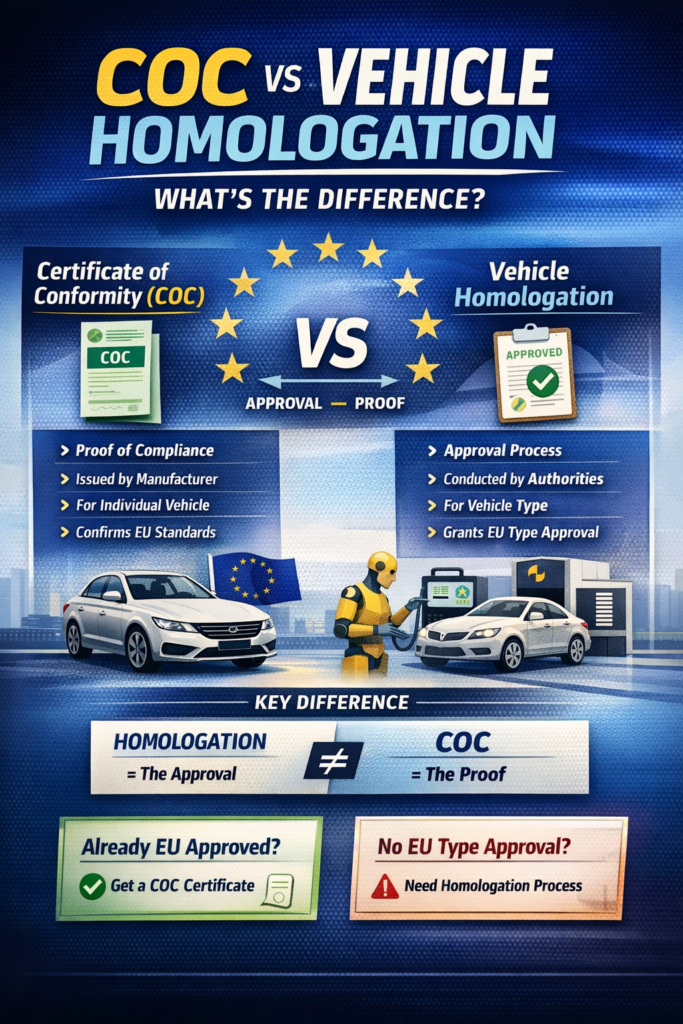
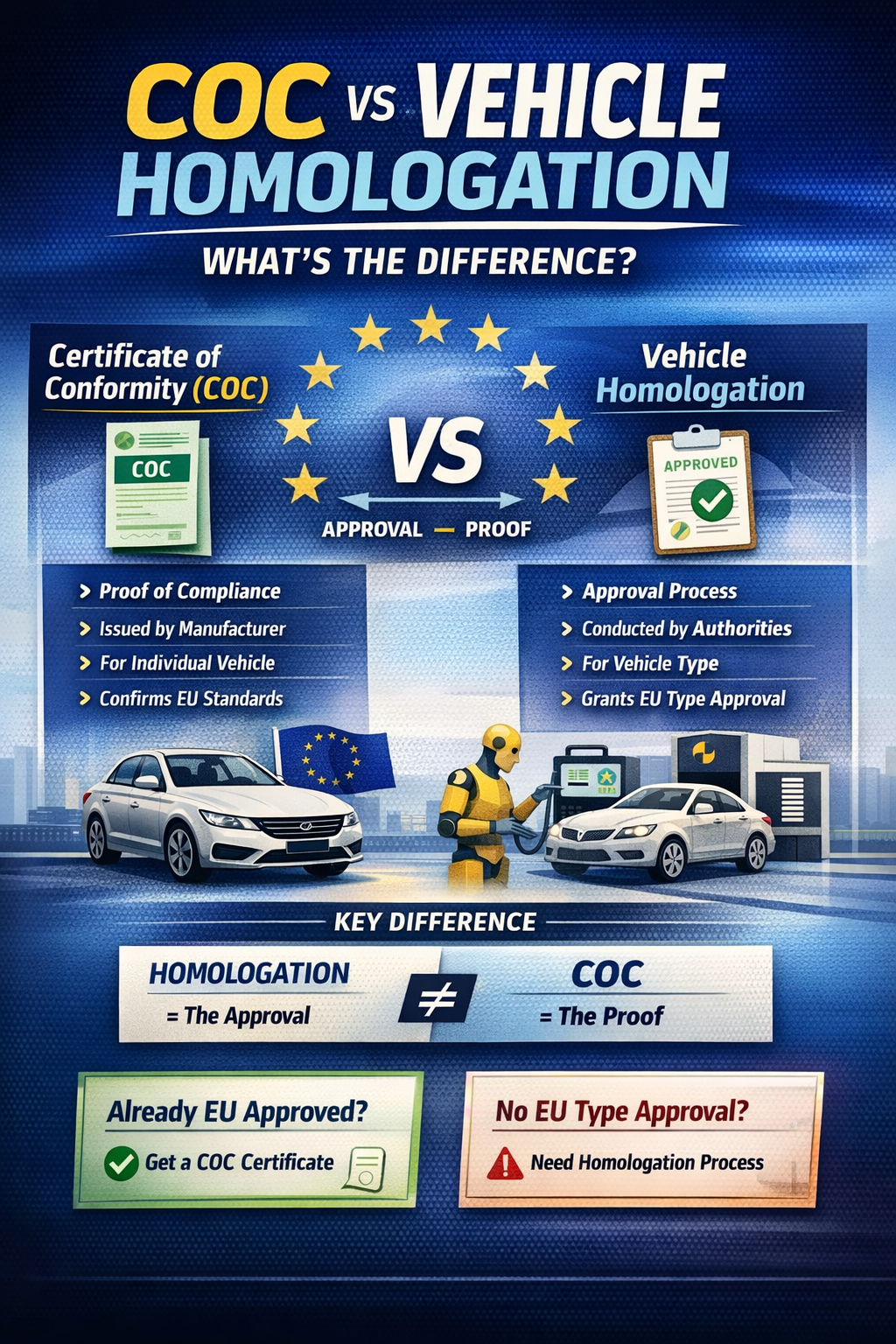
Key Difference: Approval vs Proof
| Vehicle Homologation | COC Certificate |
|---|---|
| Approval process | Documentary proof |
| Applies to vehicle type | Applies to individual vehicle |
| Conducted by authorities | Issued by manufacturer |
| Grants compliance status | Confirms compliance |
👉 Homologation = The approval
👉 COC = Evidence of that approval
Why This Difference Matters
Failing to distinguish between these concepts may result in:
❌ Ordering unnecessary approvals
❌ Paying for redundant inspections
❌ Misunderstanding registration requirements
For example:
-
A vehicle already homologated may only require a COC for registration.
-
A vehicle without EU homologation may require individual approval instead.
When Do You Need a COC Instead of Homologation?
You typically need a COC when:
✔ Registering an imported EU vehicle
✔ Re-registering a car in another EU country
✔ Authorities request technical compliance proof
In these cases, homologation already exists — the COC simply confirms it.
When Is Homologation Required?
Homologation (or individual approval) may be necessary when:
⚠ Importing a non-EU vehicle
⚠ Modifying a vehicle significantly
⚠ Registering vehicles without EU Type Approval
⚠ Missing compliance documentation
Common Misconception
“If I have a COC, my car is homologated.”
Not exactly.
A COC does not perform homologation — it confirms existing homologation.
Without EU Type Approval, a COC cannot be issued.
Practical Example
Scenario 1 – EU Vehicle
-
Vehicle already EU homologated
-
Owner imports car to another EU country
-
Registration authority requests documentation
✅ Solution → Provide COC
Scenario 2 – Non-EU Vehicle
-
No EU Type Approval
-
No homologation reference
⚠ Solution → Individual homologation process
Conclusion
Understanding the distinction between vehicle homologation and the Certificate of Conformity (COC) is critical for a smooth registration process.
In simple terms:
✔ Homologation approves the vehicle
✔ COC proves the approval
Both play different but complementary roles in vehicle compliance.