
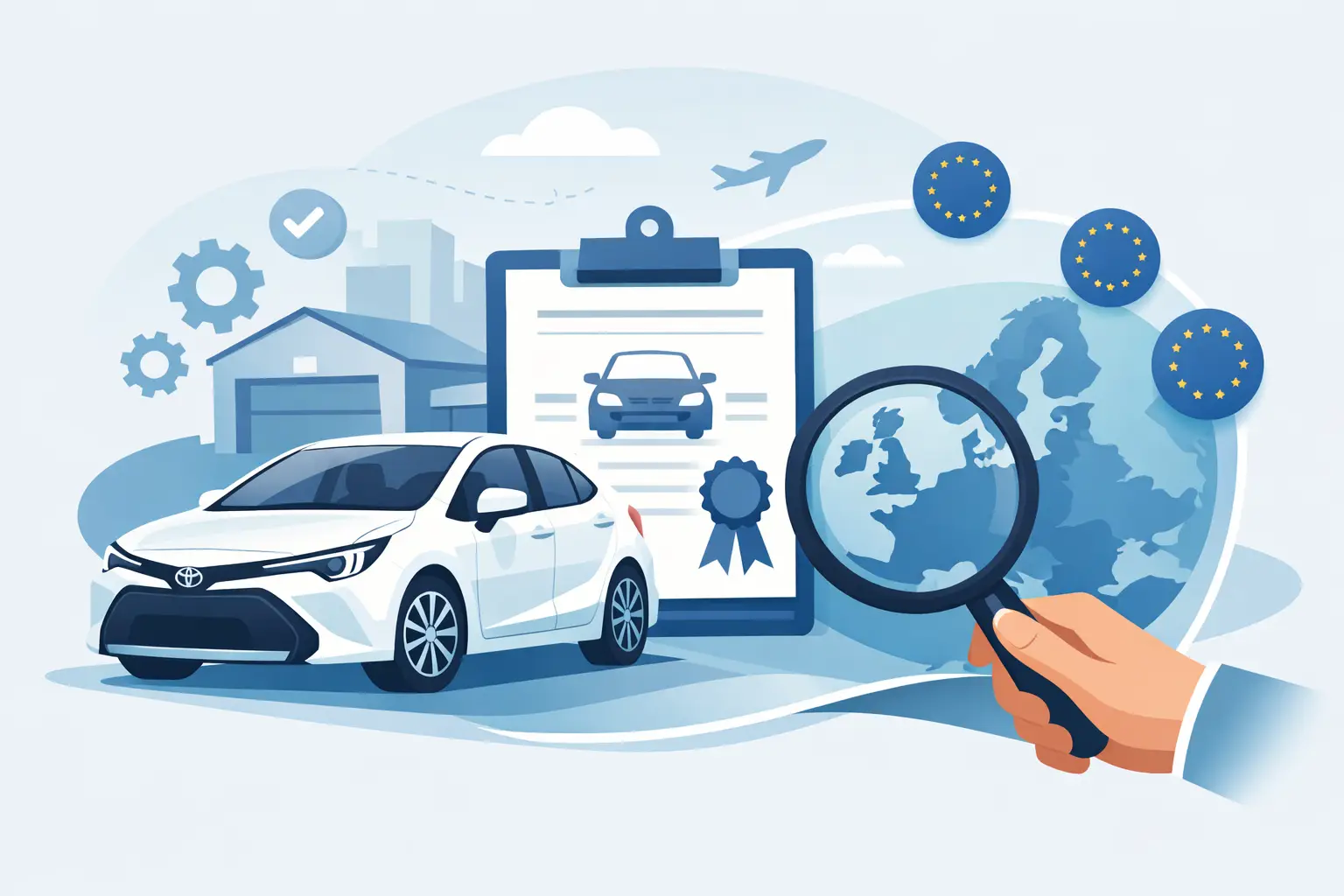
A vehicle can be mechanically perfect and still be delayed at registration because one document is missing. This Toyota COC service review focuses on the part that matters when time, money, and a cross-border registration appointment are on the line: obtaining the correct official Certificate of Conformity for the exact vehicle.
For a Toyota imported into an EU country, a Certificate of Conformity, commonly called a COC, can confirm that the vehicle was type-approved for the European market. Registration authorities may use it to verify technical data without requiring an individual approval process. The right service should make that process clear, secure, and predictable. The wrong one can leave you with an unofficial document, inaccurate specifications, or a certificate that does not match your vehicle identification number.
What a Toyota COC Service Should Deliver
A reliable Toyota COC service is not simply selling a PDF with vehicle details. The core value is access to an authentic, manufacturer-issued conformity document linked to the vehicle’s VIN. That distinction is critical. A data sheet, inspection report, registration copy, or generic specification document may contain useful information, but it is not necessarily an OEM Certificate of Conformity.
The certificate normally records the technical and environmental information needed by registration authorities, such as the type approval number, emissions classification, engine capacity, power output, weights, dimensions, tire and wheel specifications, and CO2 information where applicable. Requirements vary by country and by vehicle category, but the document must accurately reflect the original EU-approved configuration.
A good provider also makes the ordering path practical. You should be able to identify the Toyota model, submit the VIN, see the expected processing timeframe, understand the price before payment, and receive confirmation that your request is under review. For private owners, dealers, and registration agents, that clarity prevents avoidable back-and-forth when an appointment is already booked.
Toyota COC Service Review: The Checks That Matter
When assessing a Toyota COC service, begin with authenticity. The provider should state plainly that the certificate is official and sourced through the manufacturer process. Avoid services that blur the line between an original COC and a replacement document they created themselves. If the registration office has specifically requested an OEM COC, a substitute can create delays and additional costs.
The VIN check is equally important. A COC is vehicle-specific, not just model-specific. A Toyota RAV4, Corolla, Yaris, Hilux, Land Cruiser, or Prius may have different technical approvals based on production year, engine, destination market, and factory configuration. Enter the complete 17-character VIN carefully. One incorrect character can lead to a failed application or a certificate that cannot be used for your vehicle.
Processing time deserves a realistic review rather than a promise of instant delivery. Official documents require validation against manufacturer records, and some cases need manual review. Express handling can reduce unnecessary waiting, but no legitimate provider should guarantee a document before confirming that the vehicle is eligible. If a Toyota was not originally built for the European market, an EU COC may not exist at all.
Pricing should also be transparent. The quoted amount should cover the certificate request and delivery method, with any optional express service or tax treatment explained before checkout. The lowest advertised price is not always the best value if it excludes tracking, secure delivery, support, or the official document itself. In registration work, paying once for the correct certificate is generally less expensive than restarting the process after a rejected submission.
Is Your Toyota Eligible for a COC?
Most modern Toyotas originally supplied to an EU or European Economic Area market can be eligible for a Certificate of Conformity, provided the manufacturer has an applicable type approval record. However, eligibility is not automatic. The vehicle’s market of origin is often the deciding factor.
A Toyota imported from Japan, the United States, Canada, Australia, or another non-European market may not have an EU COC. Even when the model name is sold in Europe, the non-EU version may use different lighting, emissions, safety, or technical specifications. In that situation, the registration authority may require individual vehicle approval, a technical inspection, or a national data document instead.
Modified vehicles can also require additional attention. Changes to suspension, wheels, lighting, towing equipment, engine output, or emissions systems may affect the registration process. An original COC confirms the vehicle as manufactured and type-approved. It does not automatically approve later modifications. If the vehicle differs from the factory configuration, confirm local requirements before relying on the COC alone.
Older vehicles are another case where expectations should be managed. European COCs became widely used with modern EU type approval systems, but some older Toyota models may not have a COC available. A dependable service should verify availability rather than take payment based only on a model name.
What to Prepare Before You Order
Having accurate information ready makes the request faster and reduces the chance of a mismatch. You will normally need the full VIN and basic vehicle identification, including the Toyota model and production year. Keep a copy of the current registration document nearby, as it can help confirm the VIN and technical details if questions arise.
If you are registering the vehicle in a country different from its previous registration country, check what the local authority requires before ordering. Some offices require the original paper COC, while others may accept a manufacturer-issued duplicate or a specific delivery format. The COC supports registration, but it is only one part of the file. Proof of ownership, identity documents, tax or customs records, insurance, and inspections may still be required.
For commercial vehicles, camper conversions, caravans, and motorcycles, the registration route can be more specialized. Weight ratings, body type, emissions data, and conversion status often receive closer review. A provider that handles multiple vehicle categories is useful, but the same rule applies: the document must correspond to the vehicle’s original approval and your registration authority’s requirements.
How the Order Process Should Work
A dependable ordering process is straightforward. First, choose Toyota as the manufacturer and provide the VIN exactly as shown on the vehicle and registration paperwork. The service should then assess whether an official COC can be issued for that vehicle. This eligibility step protects you from ordering a document that does not exist.
After confirmation, the request moves through the manufacturer documentation process. You should receive order confirmation and a clear indication of the expected delivery window. If a VIN issue, non-EU origin, or missing approval record prevents issuance, the provider should communicate that outcome promptly instead of leaving the request unresolved.
Secure payment and careful handling of personal information matter because a VIN and ownership documents are sensitive vehicle records. Choose a provider with a professional checkout process, identifiable service terms, and direct support channels. COC-Express.eu is designed around this need, combining manufacturer-sourced documentation, transparent processing, and EU-wide service in one ordering process.
Common Mistakes That Cause Registration Delays
The most common mistake is assuming every Toyota qualifies for an EU COC. Eligibility depends on the original market and approval record, not simply on the badge on the hood. A quick VIN assessment before ordering is far safer than finding out at the registration desk.
Another mistake is ordering too late. A COC request should be started before a registration appointment, especially when importing a vehicle for resale, relocation, fleet use, or a customer handover. Allow enough time for document processing and for any follow-up required by the authority.
Finally, do not confuse a COC with proof that every local obligation has been met. It can streamline technical approval, but country-specific tax, inspection, translation, and licensing rules still apply. Treat the certificate as the official technical foundation of the registration file, not the entire file.
Before you commit to a Toyota COC service, verify authenticity, VIN-based eligibility, processing expectations, and delivery format. Those four checks turn a potentially frustrating paperwork task into a controlled next step toward registration.