
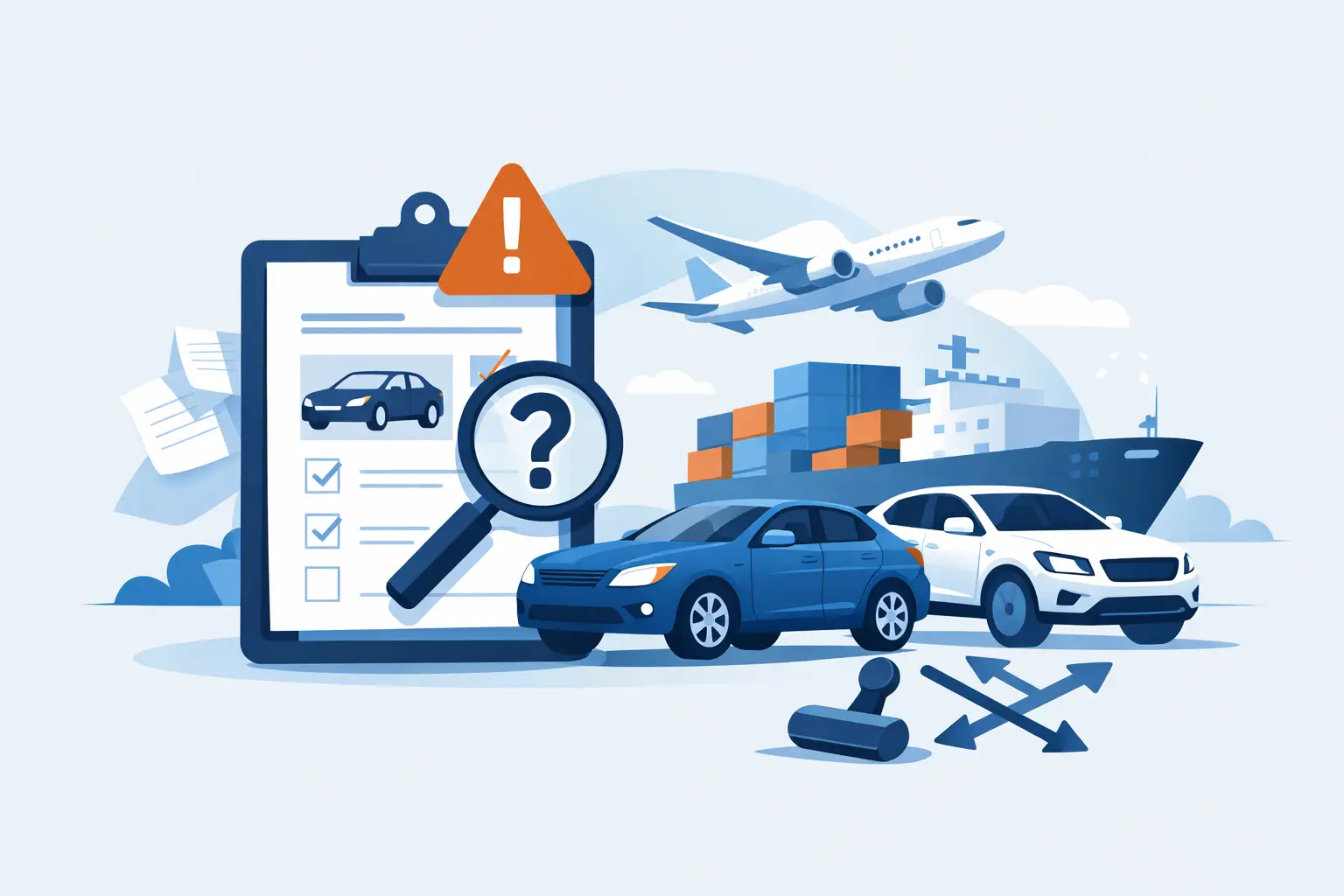
A vehicle can arrive at its destination on schedule and still sit unregistered for weeks. The top mistakes with import paperwork usually happen before shipping: a missing original, an incorrect VIN, or an assumption that customs clearance automatically means the vehicle can be titled and registered. For private owners, dealers, and transport professionals, the cost is more than inconvenience. It can mean storage fees, missed delivery dates, and a vehicle that cannot legally be used.
The reliable approach is to treat import documents as one connected file. Customs, tax, ownership, technical compliance, and local registration authorities may each require different evidence. A document that satisfies one office may not satisfy the next.
1. Confusing customs clearance with registration approval
Customs clearance confirms that the vehicle has been declared correctly for import and that applicable duties, taxes, or exemptions have been handled. It does not automatically confirm that the vehicle meets the technical and administrative requirements for registration.
This distinction matters most when a vehicle is moved into Europe from the United States, Canada, Japan, or another non-EU market. A customs declaration, bill of lading, and proof of tax payment may release the vehicle from the port, but the registration authority can still request proof of conformity, an inspection report, translated ownership documents, or local technical modifications.
Before the vehicle is shipped, identify the full registration checklist for the destination country. Ask specifically what is required for an imported vehicle rather than relying on rules for locally registered used vehicles. Requirements can differ based on the vehicle’s age, fuel type, first registration date, country of origin, and whether the import is private, commercial, temporary, or part of a relocation.
2. Using a title or purchase document that does not prove ownership
A signed sales contract is useful, but it may not be enough. Registration authorities and customs offices generally need a clear chain of ownership that matches the vehicle identification number and the importer’s identity. A title that is still marked with a lien, a bill of sale without the VIN, or an invoice issued to a different buyer can create immediate questions.
Original documents are often required. Scans may be accepted at the booking or pre-check stage, but an authority can require the original title, registration certificate, export certificate, or notarized transfer document before final approval. Do not ship originals separately without tracking, and do not assume a digital copy will replace them.
If there is a finance company, leasing company, estate, dealership, or business entity involved, confirm who has authority to transfer the vehicle. The name on the paperwork should be consistent throughout the file. Small differences in names, addresses, or company details can lead to manual review.
3. Treating the VIN as a routine detail
The VIN is the reference point for every major import document. One incorrect character can make a customs entry, certificate, inspection record, invoice, or title appear to refer to a different vehicle. The common errors are easy to miss: confusing 0 with O, entering I instead of 1, omitting a character, or copying a VIN from an informal listing rather than the vehicle itself.
Verify the full 17-character VIN directly from the vehicle and compare it against every document before submitting anything. Check the windshield plate, chassis stamping where applicable, title, purchase invoice, shipping instructions, insurance documents, and technical records. The make, model, body type, engine or motor specification, color, and model year should also be reasonably consistent.
A VIN mismatch is not always a simple correction. Once a declaration has been filed or a certificate has been issued, changing it may require a formal amendment and additional processing time. It is faster to stop the file before submission than to explain conflicting records later.
4. Ordering the wrong conformity document, or ordering it too late
For many vehicles entering or moving within Europe, technical conformity is central to registration. Yet importers often wait until the vehicle is at the port or registration office before checking whether an official Certificate of Conformity is available and accepted.
An OEM Certificate of Conformity, commonly called a COC, is designed for vehicles that were type-approved for the relevant European market. It can provide the technical information authorities need to process registration. It is not a universal substitute for every vehicle or every situation. A U.S.-spec vehicle, an individually modified vehicle, an older model, or a vehicle not covered by EU type approval may require individual approval, testing, or a local data sheet instead.
The key is to confirm the vehicle’s status before committing to the import timeline. Order only an authentic manufacturer-issued document matched to the exact VIN. A generic specification sheet, an unofficial template, or data copied from a similar model may be rejected. COC-Express.eu helps customers obtain official OEM COCs across many brands, but the registration authority remains the final decision-maker on what it will accept.
5. Assuming every destination uses the same requirements
Import rules are not interchangeable. Even within Europe, procedures vary by country and sometimes by local registration office. One authority may accept a foreign registration certificate with a certified translation, while another may request a translated purchase agreement, tax receipt, inspection certificate, and proof of identity. Some jurisdictions require an appointment before the vehicle can be inspected or titled.
This is where many dealers and private importers lose time. They prepare a file based on a previous import into another country, then discover that the destination authority wants a different format or an additional document. The fact that a vehicle was previously registered in an EU country can simplify some steps, but it does not eliminate local requirements.
Build your checklist around the final registration location, not the departure location or shipping agent’s standard package. If you use an agent, ask for the exact document list in writing and confirm who is responsible for customs, tax evidence, technical approval, inspections, translations, and registration submission.
6. Ignoring translations, legalization, and document format rules
A valid document can still be unusable if it is presented in the wrong language or format. Authorities may require certified translations for titles, bills of sale, powers of attorney, or foreign registration records. In some cases, documents issued abroad may need an apostille, legalization, or a notarized copy.
Do not translate documents casually after a rejection. First, ask whether a certified translation is required and whether the translator must meet a local standard. Also confirm whether the authority wants the original document, a certified copy, or both. Sending a translation without the original source document can create another delay.
Keep every document readable. Cropped scans, phone photos with glare, missing reverse sides, and low-resolution copies cause avoidable follow-up requests. Create a secure digital folder, name files clearly, and retain physical originals in one protected location.
7. Declaring the wrong value or relying on an unrealistic invoice
The declared vehicle value affects duty, tax, and compliance review. An invoice that appears significantly lower than market value can trigger questions, requests for payment evidence, or a revised assessment. The same applies when the purchase price excludes items that should be declared, such as certain transport, insurance, or related costs under the applicable valuation rules.
Use accurate, supportable figures. Retain the purchase agreement, bank transfer confirmation, auction record, dealer invoice, and any documents showing the vehicle’s condition if that condition affected the price. A damaged or non-running vehicle may have a lower value, but the file should make that fact clear.
Trying to reduce the declared value can create a much larger problem than the tax saving. Delays, penalties, and a challenged declaration can affect the entire import process.
8. Forgetting that modifications can change the approval path
A vehicle may have left the manufacturer fully compliant, then been changed by a previous owner. Common examples include aftermarket lights, window tint, suspension changes, wheels and tires outside approved specifications, exhaust systems, tow equipment, and engine modifications. These changes can affect inspections and registration even when the ownership and customs paperwork is perfect.
Review the vehicle as it will be presented for inspection, not as it appeared in the original brochure. If modifications are fitted, gather approval documents, installation records, and any relevant test certificates. In some cases, restoring the vehicle to original specification is the quickest route. In others, an individual inspection is the appropriate path. It depends on the modification and the destination country’s rules.
A clean file is the fastest route forward
Import paperwork works best when it is prepared before the vehicle moves, checked against the exact VIN, and organized for the final registration authority rather than just the border. Confirm the requirements early, use authentic source documents, and leave time for the steps that cannot be rushed. That preparation turns a difficult registration appointment into a routine one.