
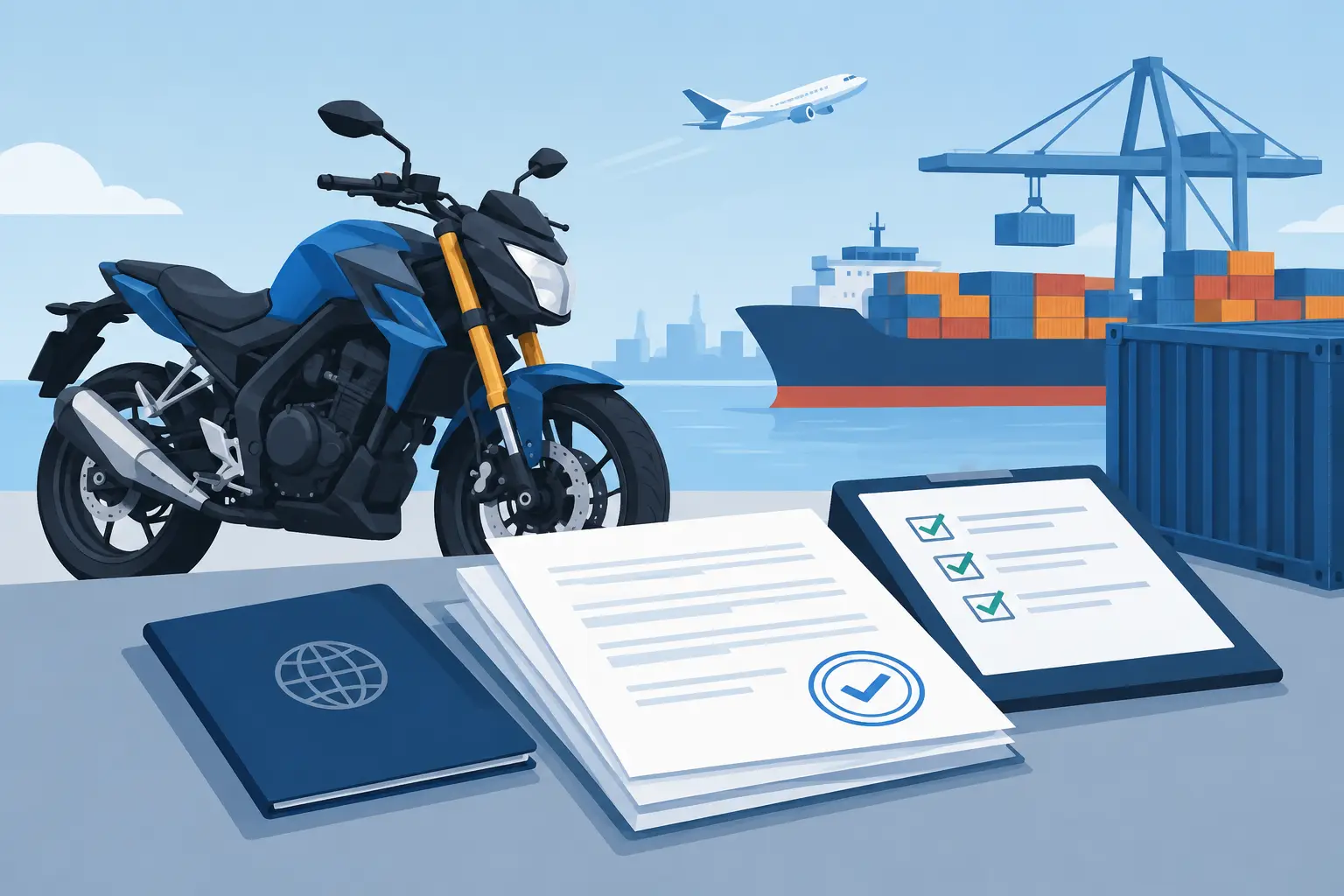
A motorcycle sitting at a port, a customs warehouse, or a registration office can become expensive quickly. A motorcycle import is not completed when the bike arrives in the destination country. It is completed when customs clearance, technical compliance, and local registration are all accepted.
For private owners, dealers, and transport professionals, the most common delays are not caused by shipping. They are caused by missing ownership paperwork, a VIN mismatch, an unexpected tax requirement, or the wrong conformity document. Preparing the file before the motorcycle moves is the fastest way to protect your delivery date and registration plan.
Motorcycle Import Starts With the Destination Rules
There is no single document package that works for every border. Requirements depend on where the motorcycle was built, where it is being imported from, its age, its technical specification, and the country where it will be registered.
A U.S.-spec motorcycle being sent to an EU country, for example, may require a different approval path than an EU-spec motorcycle returning to another EU member state. A bike purchased in Germany and registered in France may face fewer customs formalities than a motorcycle arriving from the United States, Japan, or the United Kingdom. The registration authority, not the seller or shipping company, makes the final decision on what it will accept.
Before you arrange transport, confirm four points: the destination country’s registration requirements, the applicable customs procedure, tax treatment, and whether the motorcycle has EU type approval. This early check prevents a common and costly assumption: that a title and bill of sale are enough to put any imported bike on the road.
The Core Motorcycle Import Document File
A complete file gives customs officials and registration authorities a clear chain of ownership, value, identity, and compliance. Keep original documents secure and retain clear copies for your own records. Requirements vary, but most imports involve the following records:
- Proof of ownership, such as the original U.S. title, registration certificate, or equivalent vehicle document.
- A signed bill of sale or purchase invoice showing the buyer, seller, date, purchase price, and motorcycle identification details.
- The vehicle identification number, or VIN, verified against the motorcycle frame and every submitted document.
- Shipping documents, usually a bill of lading or airway bill, identifying the shipment and consignee.
- Customs declarations, import entry records, and receipts for any duty, VAT, sales tax, or other import charges.
- Technical documentation required for registration, which may include an OEM Certificate of Conformity, an approval certificate, or an individual inspection report.
Do not treat these as separate administrative tasks. A different VIN format, engine number, model year, or owner name can trigger questions across the entire file. Check the documents together before the bike is collected by the carrier.
Ownership and Value Documents Must Tell the Same Story
Customs authorities use the invoice or bill of sale to assess declared value and applicable charges. Registration agencies use ownership documents to establish that the applicant has the right to register the motorcycle. If the price seems unusually low, if the seller’s name differs from the title, or if a salvage history is unclear, expect additional scrutiny.
A realistic purchase document is safer than an informal note with incomplete details. Include the full VIN, make, model, sale amount, currency, sale date, and contact details for both parties. For dealer purchases, keep the original commercial invoice and any payment evidence available if requested.
Shipping Papers Do Not Replace Registration Papers
A bill of lading proves that a carrier received and transported a shipment. It does not prove that the motorcycle meets road-use standards or that it can be registered. Similarly, customs release allows the motorcycle to enter under the approved customs procedure, but it does not guarantee approval at the registration counter.
This distinction matters when timing a shipment. A motorcycle can clear a port and still wait weeks for an inspection appointment, a missing COC, or a correction to the title paperwork. Plan storage, insurance, and transport from the port with this possibility in mind.
When an OEM Certificate of Conformity Helps
For many EU registrations, an original manufacturer-issued Certificate of Conformity, often called a COC, is the most direct technical document for a motorcycle built to EU whole-vehicle type approval. It identifies the vehicle and records the approved technical specifications used by registration authorities.
The key word is “many.” A COC is not a universal import document. It does not replace ownership evidence, customs clearance, taxes, or local registration fees. It also cannot change the physical specification of a motorcycle.
An OEM COC is generally relevant when the bike was originally manufactured for the European market and has an EU type approval. It may be especially useful when the original document is lost, the motorcycle is being registered in another European country, or the authority requires the manufacturer document to complete the application.
COC-Express.eu provides official OEM certificates for eligible motorcycles, helping owners and professionals obtain the manufacturer-issued document without having to navigate separate brand channels. Eligibility should always be checked using the VIN before ordering.
Why U.S.-Spec Motorcycles Need Extra Attention
A motorcycle sold new in the United States may comply with U.S. federal and state requirements without matching the approval specification required for registration in Europe. Lighting, turn signals, speedometer markings, emissions equipment, noise limits, tires, and reflectors can all matter. Even where a model looks identical to a European version, the VIN-specific approval status may be different.
This is where assumptions create expensive surprises. A European Certificate of Conformity cannot be issued simply because the bike’s model exists in Europe. The specific motorcycle must be eligible for an OEM COC. If it is not, the destination country may require an individual vehicle approval, technical inspection, engineering evidence, modifications, or another national compliance route.
Ask the registration authority or a qualified local approval specialist what is required for the exact VIN before purchase or shipment. If modifications are necessary, obtain written clarity on the standard to be met and the evidence needed after the work is completed.
Build the File Before the Motorcycle Ships
The best time to solve paperwork is while the motorcycle is still accessible to the seller. Once the bike is in transit, replacing a missing signed title, obtaining a corrected invoice, or photographing an unreadable VIN plate becomes harder.
Start by comparing the VIN character by character on the frame, title, invoice, shipping booking, and any conformity record. Confirm that the seller can provide original ownership documents and that any finance lien has been released. If the motorcycle has been modified, list the changes and determine whether original parts, receipts, or inspection evidence will be needed.
Then organize the file in the order an official is likely to review it: identity and ownership first, purchase value second, shipping and customs records third, and technical compliance documents last. Provide copies where accepted, but carry originals when collecting the motorcycle or attending registration.
Plan for Taxes, Timing, and Local Inspections
Import costs are more than freight. Depending on the route and destination, the total can include import duty, VAT or sales tax, customs brokerage, port handling, storage, inspection fees, registration fees, translation costs, and required modifications. A low purchase price does not always produce a low landed cost.
Timing also depends on the slowest step. Customs processing may be quick while a local inspection appointment is not. An OEM document can be issued faster than an authority can review it. Conversely, ordering technical paperwork early can prevent the registration process from stopping once the motorcycle arrives.
If the bike is being imported during a relocation, commercial purchase, or seasonal riding period, leave a realistic buffer. Do not schedule resale, customer delivery, or long-distance travel around the estimated arrival date alone.
The most reliable motorcycle import is the one with no unanswered questions at the counter. Verify the VIN, confirm the destination approval route, and secure authentic documents before the motorcycle begins its journey. That preparation is usually faster, less expensive, and far less stressful than resolving a refusal after arrival.