
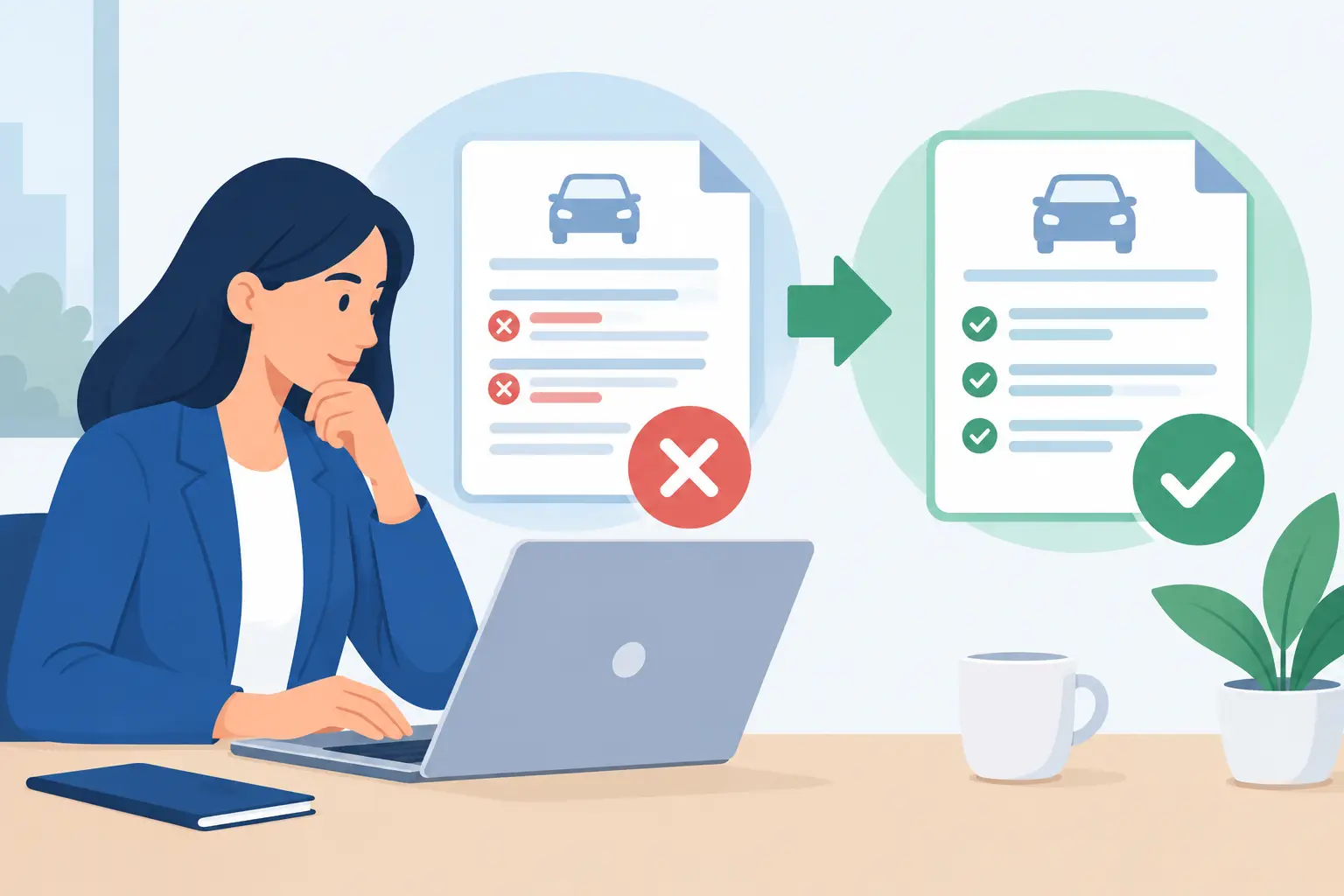
A single incorrect character on a Certificate of Conformity can stop a vehicle registration appointment. A VIN mismatch, wrong variant code, or incorrect emissions figure is not a minor paperwork issue when authorities need the document to match the vehicle exactly. Knowing how to correct COC errors helps you act quickly while protecting the validity of your registration file.
A COC is an official manufacturer-issued document. It confirms that a specific vehicle type meets the relevant European approval requirements. Because it is an OEM document, you cannot legally amend it yourself, even when the error appears obvious. The correct solution depends on whether the problem is on the certificate, in the registration authority’s records, or on the vehicle itself.
How to Correct COC Errors Without Delaying Registration
Start by identifying the exact field that does not match. Do not rely on a general statement that the document is “wrong.” Registration authorities and manufacturers need a clear discrepancy, supported by the vehicle and its official records.
Compare the COC against the vehicle VIN, the registration certificate, purchase invoice, customs paperwork where applicable, and the physical vehicle identification plate. Pay particular attention to the 17-character VIN, make and commercial designation, variant and version, engine capacity, fuel type, power output, weight figures, number of seats, tire sizes, and CO2 or emissions data.
A mistake in one field does not always mean the COC is defective. For example, an older registration document may use a shortened model name, while the COC displays the complete manufacturer designation. That can be normal. A true error is usually a conflict in a controlled technical or identity field, especially the VIN, approval number, emissions standard, or vehicle variant.
Once you identify the discrepancy, stop using the certificate for registration until it has been clarified. Submitting a document with a known inconsistency can lead to rejection, additional inspections, or a request for further evidence. It is faster to resolve the issue before your appointment than to restart the process after a refusal.
The Difference Between a COC Error and a Registration Error
The first question is simple: which document contains the wrong information?
If the VIN and technical details on the vehicle match the COC, but the local registration record contains a typo, the COC may be your evidence for correcting the registration record. In that case, the registration authority, not the manufacturer, normally handles the amendment.
If the vehicle identification plate and official manufacturer data do not match the COC, the certificate itself may need correction or replacement. This is more serious because a COC is tied to a particular approval framework and, in many cases, a specific vehicle identity. Only the manufacturer or an authorized channel can issue a corrected official document.
There is also a third possibility: the vehicle has been modified. Non-original wheels, engine changes, conversions, altered seating, tow equipment, or emissions-related modifications can create a mismatch between the vehicle and its original COC. The original COC may still be accurate, but it may no longer be sufficient for registration in its current configuration. Depending on the country and modification, you may need an inspection report, individual approval, or other technical documentation instead of a revised COC.
Common COC discrepancies
The issues most likely to cause registration delays include:
- A VIN with one incorrect letter or number
- An incorrect vehicle variant, version, or type approval number
- Engine power, fuel, or displacement figures that do not match OEM data
- Incorrect weights, axle loads, seating capacity, or dimensions
- An emissions class or CO2 value that conflicts with the vehicle record
- A COC issued for a similar vehicle rather than the exact vehicle being registered
Some details can vary by market or date of first registration, so do not assume every difference is an error. Technical authorities may apply national formatting rules or use a different unit display. Identity fields, however, should never be approximated.
Contact the Right Party With Complete Evidence
For a genuine COC issue, contact the party that supplied the certificate or the manufacturer channel responsible for issuing it. Provide the document number, a clear description of the discrepancy, the complete VIN, and readable copies of the supporting documents. Clear evidence reduces back-and-forth and helps the issuer verify the vehicle in the OEM database.
Avoid sending only a message such as “my COC has an error.” State the field name, the value shown on the certificate, the value shown on the vehicle or official record, and why you believe the latter is correct. For example: “Field 0.10, VIN: the certificate shows WBA123…, while the VIN plate and registration certificate show WBA124….”
Keep your original COC secure while the matter is reviewed. Do not write on it, erase information, scan over fields, or attempt a digital edit. Altering an official conformity document can make it unacceptable to the registration authority, even if your intention was only to correct a clerical mistake.
If the original document was lost or damaged, request a replacement rather than trying to reconstruct it from a scan. A replacement COC must remain traceable to the manufacturer and should be issued through a legitimate OEM source.
When a Replacement COC Is Required
A replacement is typically necessary when the original COC contains a confirmed manufacturer or production-data error, is unreadable, has been damaged, or cannot be accepted because it belongs to another vehicle. It may also be required when an incorrect certificate was supplied for a vehicle with a similar model name but different approval details.
A corrected replacement is not always instantaneous. The issuer may need to check archived production information, homologation records, and the vehicle’s original specification. Older vehicles, discontinued brands, gray imports, and vehicles first registered outside the EU can require additional review. Speed depends on how complete the manufacturer data is and whether the vehicle was originally built for the European market.
This is why ordering based on the VIN matters. A valid COC is not a generic model brochure or a downloadable template. It must correspond to the vehicle’s approved configuration. Services such as COC-Express.eu help owners and professionals request authentic OEM documentation through a single secure process, particularly when dealing with multiple vehicle brands or cross-border registration requirements.
Prepare for the Registration Office After the Correction
When you receive the corrected or replacement document, review it before booking another registration appointment. Check the VIN character by character, then compare the approval number, make, model designation, power, fuel type, weights, and emissions information against the vehicle and the paperwork required in your destination country.
Bring both the new COC and any written confirmation explaining the replacement, if available. Some authorities may retain the original certificate or ask why a second document was issued. A clear paper trail prevents unnecessary questions.
If the authority still rejects the corrected COC, ask for the reason in writing. The issue may be a local registration requirement rather than a flaw in the certificate. For example, the office may require a translation, proof of ownership, tax clearance, a technical inspection, or documentation for modifications. Written clarification lets you solve the actual problem instead of ordering documents repeatedly.
Avoid preventable COC mistakes
The most effective protection is to verify the VIN before ordering and again immediately after receiving the certificate. Use the VIN from the vehicle itself, not only from an advertisement, insurance policy, or handwritten sales document. Characters such as 0 and O, 1 and I, or 5 and S are easily confused.
For dealerships, importers, and fleet managers, establish a simple verification step before submitting a registration file. Match the VIN on the vehicle, purchase records, COC, and customs documents in one review. That small control can prevent a vehicle from sitting unregistered while a replacement is requested.
A corrected COC should give the registration authority confidence, not create a new question. Treat every discrepancy as a traceability issue, document it clearly, and request correction only through an authorized OEM route. That approach keeps your file credible and gives your vehicle the best chance of moving through registration without another avoidable delay.