
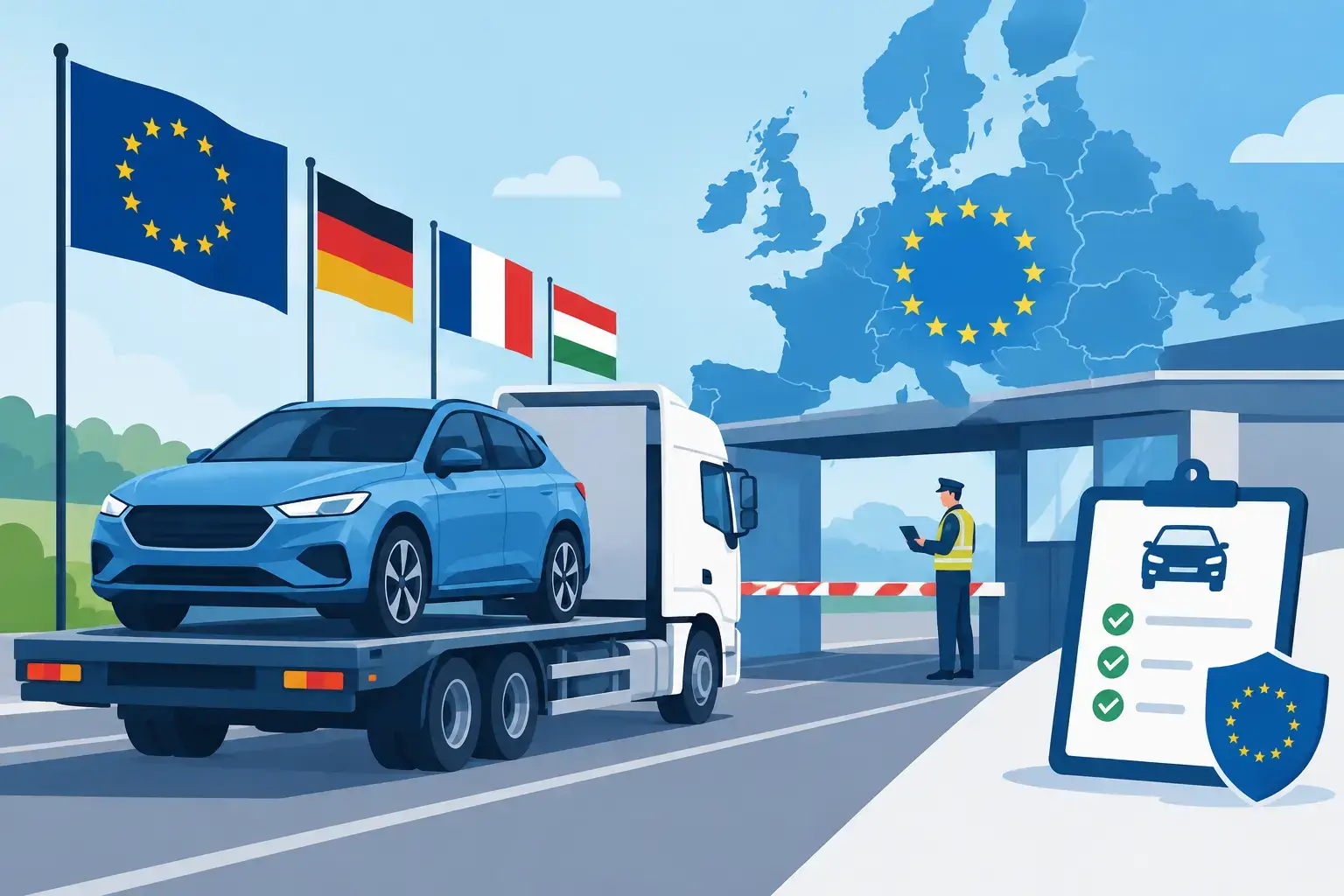
A vehicle can arrive at its destination in perfect condition and still be impossible to register. The usual cause is not transport damage or a missing key. It is paperwork. Cross border vehicle regulations determine whether the vehicle can be accepted by the local registration authority, taxed correctly, insured, and legally driven.
For U.S. residents moving to Europe, dealers selling across borders, and buyers importing a used vehicle, the practical question is simple: can this exact vehicle be registered in the destination country without costly delays? The answer depends on where the vehicle was first approved, its technical specifications, its tax status, and the documents available to prove compliance.
Why Cross Border Vehicle Regulations Are Not One Rulebook
Europe has shared vehicle type-approval rules, but registration remains a national process. That distinction matters. A vehicle that was originally sold and approved for the EU market will usually have a clearer path to registration in another EU country. A vehicle imported from the United States, Canada, Japan, or another non-EU market may require individual approval, modifications, or additional testing.
The destination country applies its own registration procedures, fees, inspections, and tax rules. Local authorities may also interpret technical evidence differently. For example, one country may accept an existing technical inspection, while another requires a domestic inspection before plates can be issued.
This is why buyers should never assume that a vehicle with valid registration in one country can simply be transferred to another. Registration proves that the vehicle was accepted where it was registered. It does not automatically prove it meets every requirement in the next country.
Start With the Vehicle’s Original Market Approval
The first check should be whether the vehicle has EU Whole Vehicle Type Approval. Most cars, motorcycles, motorhomes, and commercial vehicles originally manufactured for the European market have an EU type-approval number and are supported by a manufacturer-issued Certificate of Conformity, often called a COC.
A COC confirms the technical specifications assigned to that vehicle under its approved type. Depending on the vehicle and model year, it can include the VIN, engine details, emissions standard, power output, weights, dimensions, tire information, noise level, and CO2 data. Registration authorities use this information to create local registration records and calculate certain taxes or fees.
A COC is particularly valuable when the original document has been lost, when a vehicle is being registered in a different EU country, or when the registration office requires official manufacturer evidence instead of a dealer printout. It is not a replacement for ownership documents, customs clearance, or tax payment proof. It is technical conformity evidence, and it must match the vehicle exactly.
If the vehicle was built for a non-EU market, a European COC may not exist. That does not necessarily make import impossible. It means the process may shift from standard type approval to individual vehicle approval. This route can be more expensive and less predictable because the vehicle may need changes to lighting, emissions equipment, speedometer markings, rear fog lights, or other market-specific components.
Documents That Usually Control Registration
The exact file varies by country and vehicle history, but most cross-border registrations require a clear chain of ownership, technical data, and tax or customs evidence. Before shipping a vehicle or committing to a purchase, confirm that you can provide the following:
- Original registration certificate or title from the country where the vehicle was previously registered.
- Bill of sale, purchase invoice, or other proof of ownership.
- Valid identification and proof of residence where required by the registration authority.
- Manufacturer-issued Certificate of Conformity for EU-approved vehicles, or an individual approval document where no COC is available.
- Customs declaration and duty or VAT evidence when the vehicle enters the EU from outside the customs area.
- Inspection documentation if the destination country requires a roadworthiness, technical, or identity inspection.
Original documents matter. A registration office may reject photocopies, incomplete translations, altered records, or technical data that does not match the VIN. If a vehicle has been modified, the original COC may no longer be sufficient on its own. Suspension changes, aftermarket wheels, engine modifications, towing equipment, lighting conversions, and camper conversions can trigger separate approval requirements.
VAT, Customs Duty, and the “New Means of Transport” Rule
Tax treatment is often the part of cross border vehicle regulations that surprises private buyers. Moving a vehicle between EU countries is not the same as importing a vehicle from outside the EU.
For a used vehicle purchased and moved between EU member states, customs duty does not normally apply. However, VAT rules can still apply depending on the transaction, seller status, and whether the vehicle is treated as a “new means of transport.” Under EU rules, a vehicle can be considered new for VAT purposes if it is less than six months old or has traveled no more than 6,000 kilometers. In that situation, VAT is generally due in the destination country, even if the vehicle was bought in another EU country.
For a vehicle entering the EU from the United States or another non-EU country, import duty and import VAT may be due before registration. Some relocation cases qualify for relief, but eligibility is specific and usually depends on residency, length of prior ownership, personal use, and restrictions on selling the vehicle after import. Do not rely on an assumption that a personal vehicle automatically enters duty-free.
National registration taxes may apply on top of customs duty and VAT. These taxes can be heavily influenced by CO2 emissions, fuel type, engine size, age, value, or weight. An official COC is often central to proving the emissions and technical values used in that calculation.
Inspections, Modifications, and Country-Specific Requirements
A valid COC makes the registration process more straightforward, but it does not eliminate every local step. Authorities may still inspect the VIN, verify the vehicle’s physical condition, or require a periodic roadworthiness test. Some countries also require proof that the vehicle is not subject to an outstanding lien, theft report, or export restriction.
Imported U.S.-specification vehicles deserve particular attention. Headlights designed for right-side traffic may be acceptable in some cases and unsuitable in others. Rear turn signal color, side markers, speedometer units, emissions labels, and rear fog lamp requirements can all affect approval. The work required may be minor for one model and substantial for another.
Commercial vehicles, caravans, and converted vehicles can involve further checks. Weight ratings, seating capacity, axle loads, tachograph requirements, braking systems, and body alterations may need to be documented. A vehicle that was legal for private use in its previous country may face different rules when registered or operated commercially.
A Practical Order of Operations
The most reliable approach is to validate compliance before transport, not after the vehicle is parked outside the registration office. Begin by confirming the VIN, the original market, the current title status, and the destination country’s registration requirements. Then establish whether an official COC is available or whether individual approval will be necessary.
Next, calculate the full cost. Include purchase price, transport, customs duty where applicable, VAT, national registration tax, inspection fees, modifications, insurance, temporary plates, and document replacement costs. A low purchase price can lose its advantage quickly if the vehicle requires individual approval or major technical alterations.
Finally, organize the original documents before booking an appointment. If the COC is missing, order an authentic manufacturer-issued replacement early. COC-Express.eu provides official OEM Certificates of Conformity for a broad range of vehicle brands, helping owners and professionals obtain the exact document required for EU registration procedures.
When a Certificate of Conformity Is Not Enough
A COC supports standard registration only when it reflects the vehicle as presented. It cannot resolve a title dispute, prove customs duty was paid, or override a local ban on a non-compliant vehicle. It also cannot certify modifications made after the vehicle left the factory.
For older vehicles, rare models, gray-market imports, and heavily modified vehicles, individual approval may be the correct route. That process can still be successful, but it should be assessed before purchase. Ask the destination authority or an approved technical inspection body which tests, conversions, and documents will be required for that specific VIN.
The fastest registration is rarely achieved by rushing paperwork at the end. It comes from confirming the vehicle’s approval status, tax exposure, and original documentation before the vehicle crosses the border. When every record supports the same VIN and technical specification, the registration process has far fewer reasons to stop.