
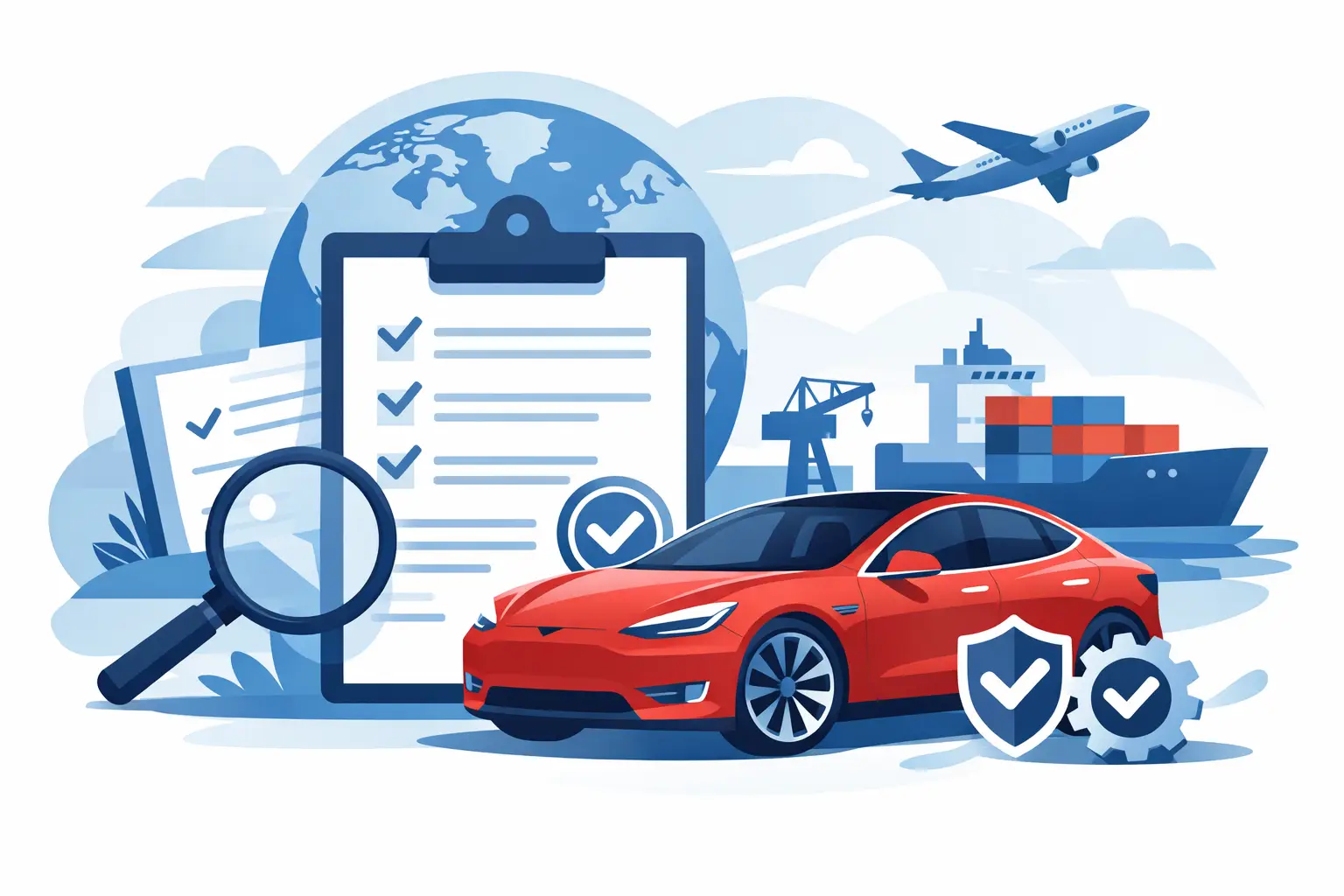
A Tesla arrives, the payment clears, transport is booked, and then registration stops on one document: the certificate of conformity for Tesla import. That delay is common, especially when a vehicle crosses borders inside Europe or enters an EU country from another market. If the registration office asks for proof that the vehicle matches EU type approval, the right document can save days of back-and-forth and prevent expensive administrative mistakes.
What the certificate of conformity for Tesla import actually does
A Certificate of Conformity, usually called a COC, is an official manufacturer-issued document. It confirms that a specific vehicle was produced in line with an approved EU type approval and lists the technical data used by registration authorities. For a Tesla, that can include details such as VIN, variant, version, mass, emissions classification where applicable, and other approval-related specifications.
For importers, owners, dealerships, and registration agents, the value is simple: it gives the authority a standardized OEM document to verify compliance. That matters because registration offices are not trying to interpret sales invoices, transport papers, or informal spec sheets. They want an official document tied to the vehicle and issued through the proper manufacturer channel.
This is also why not every Tesla import case looks the same. A Tesla originally built for the European market often fits the COC process more directly. A Tesla from the US or another non-EU market may trigger additional checks, and in some cases a COC may not be available in the same way if the vehicle was not covered by EU type approval at production.
When a Tesla COC is required
In many EU registration cases, the COC is requested when a vehicle is being registered in a different member state from the one where it was first delivered, or when a used car is brought into a new national system. It is particularly relevant for:
- private owners relocating with a Tesla
- used-car buyers importing a Tesla from another European country
- dealers moving Tesla stock across borders
- fleet operators and registration agents handling multiple transfers
The reason is administrative consistency. The registration authority needs a reliable basis for entering the vehicle into the local database. If the Tesla already has harmonized technical data through its EU approval record, the COC is often the fastest route.
That said, requirements still depend on the country and the vehicle history. Some authorities accept existing national registration papers for certain intra-EU transfers, while others still request the COC to complete the file. If the car has been modified, rebuilt, or imported from outside the EU approval framework, the process can shift from standard registration to individual approval or a national inspection route.
Which Teslas usually qualify for a COC
The key question is not simply whether the car is a Tesla. It is whether that exact vehicle was manufactured under a valid EU type approval. Many European-market Model 3, Model Y, Model S, and Model X vehicles can be matched to a manufacturer-issued COC if they were originally built and supplied for the EU market.
Problems usually appear when a Tesla was first sold in the US, Canada, or another non-EU region. Even if the car looks nearly identical, registration authorities care about the approval basis, not visual similarity. Lighting, safety equipment, charging configuration, and software-related specifications can differ by market. A non-EU Tesla may therefore need a different compliance path instead of a standard COC.
This is where document accuracy matters. Ordering the wrong paperwork wastes time. The VIN must be checked against the manufacturer record so the correct document route is used from the start.
What information is included in a Tesla Certificate of Conformity
A valid OEM COC is not a generic brand certificate. It is linked to one specific vehicle. For registration purposes, that precision is the whole point.
The document generally includes the vehicle identification number, manufacturer details, approval number, model and variant data, permitted weights, dimensions, and other technical characteristics required by authorities. For an electric vehicle like Tesla, the data set differs from an internal combustion vehicle, but the principle is the same: the document provides official approval-linked specifications that support registration.
If a registration office asks for technical proof, a manufacturer-issued COC carries far more weight than dealer brochures, screenshots, or unofficial translations. Authorities want a formal compliance document, not an approximation.
How to get a certificate of conformity for Tesla import without delays
The fastest process usually starts with one thing: a correct VIN check. Before any order is placed, the vehicle should be identified precisely so the document request matches the manufacturer record. A mismatch in digits, model year confusion, or a misunderstanding about market origin can stall the request immediately.
After that, the important factor is sourcing. For legal registration use, the document should be an official OEM Certificate of Conformity, not a recreated data sheet sold as if it were equivalent. Those are not the same product, and authorities may treat them very differently.
A specialized provider can reduce friction because the process is already built around manufacturer-backed sourcing, secure ordering, and time-sensitive compliance needs. For buyers handling imports under pressure, that matters more than general information. The goal is not to research paperwork for a week. The goal is to get the right document, issued properly, and delivered fast enough to keep registration moving.
Common reasons Tesla import registration gets stuck
Most delays come from one of three issues. The first is assuming every Tesla can receive a COC. If the vehicle was not produced under EU type approval, the request may fail or require a different document path.
The second is relying on unofficial paperwork. Registration authorities are cautious for a reason. A vehicle being entered into a national system needs authentic technical proof. If the document does not come from the proper source, the file may be rejected.
The third is waiting too long to order. Importers often focus on shipping, customs, tax, and insurance first, then discover the registration authority needs the COC before plates can be issued. That creates avoidable downtime, especially for dealers, fleet managers, and professionals working against delivery commitments.
Is a Tesla COC enough on its own?
Sometimes yes, sometimes no. The COC is often the central compliance document for EU registration, but it is not the only paperwork involved in an import file. Authorities may also request proof of ownership, prior registration documents, ID, customs documentation where applicable, proof of tax status, or inspection records.
For a straightforward intra-EU transfer of an EU-spec Tesla, the COC can remove the main technical obstacle. For a non-EU vehicle or a car with modifications, the authority may still require additional inspection or homologation steps. That is why speed matters, but accuracy matters more. The right first step depends on the VIN and market history.
Why authenticity matters more than price
Cheap paperwork becomes expensive when registration stops. If a Tesla is sitting unregistered, the hidden costs add up quickly: storage, delayed resale, missed handover dates, transport disruption, and repeated visits to registration offices. For commercial operators, the real loss is time.
That is why buyers who understand the process prioritize authenticity and reliability over guesswork. An official manufacturer-issued document gives the authority what it expects and reduces the risk of rejection. A secure order process, transparent handling, and clear delivery expectations are not extras in this market. They are the service.
For many importers, using a specialist such as COC-Express.eu is the practical choice because the focus is not generic customer support. It is obtaining the exact OEM conformity document required for registration, quickly and securely.
Before you order a Tesla COC
Have the VIN ready and verify where the vehicle was originally built for sale. If the Tesla came from the EU market, a Certificate of Conformity is often the cleanest route to registration. If it came from outside the EU, confirm eligibility before assuming a COC exists for that vehicle.
That small check can prevent the most common import mistake: pursuing the wrong document while the registration clock keeps running. When the paperwork is right from the start, a Tesla import becomes a registration task, not an administrative problem.