
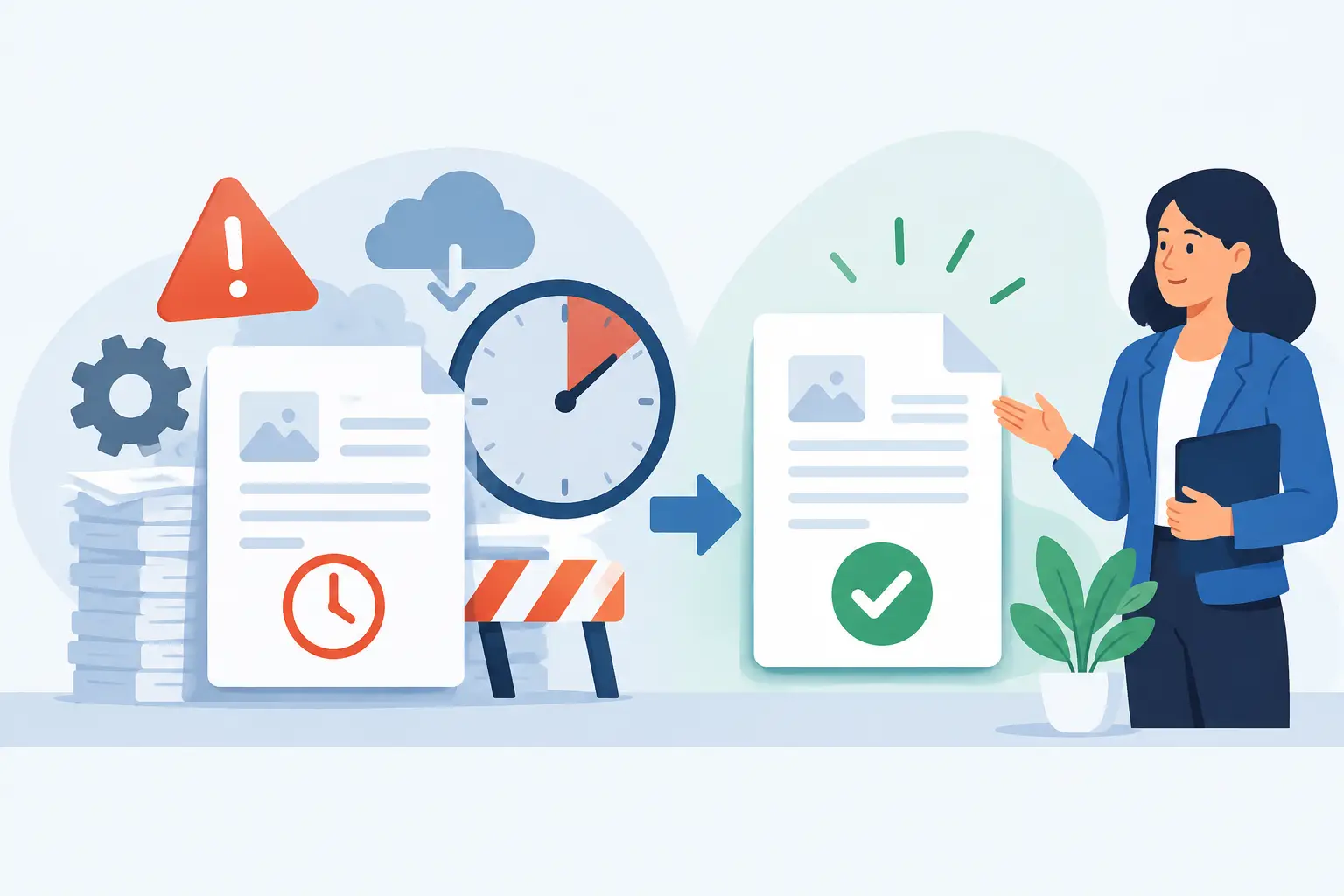
A vehicle can be at the registration office, booked for inspection, and ready to drive – yet still be held up by one missing document. COC delay causes are often administrative, but their effect is immediate: missed registration appointments, delayed imports, storage costs, and an unusable vehicle.
A Certificate of Conformity is an official manufacturer-issued document confirming that a specific vehicle was built in line with its approved European type approval. Because it is tied to the exact vehicle, the process cannot always be treated like ordering a generic replacement document. Accurate vehicle data, manufacturer records, and eligibility checks all matter.
The Most Common COC Delay Causes
The majority of delays begin before the certificate request reaches the manufacturer. A small mismatch in the submitted information can require manual verification and stop an otherwise straightforward order from progressing.
Incorrect or incomplete VIN details
The Vehicle Identification Number is the foundation of a COC request. One incorrect character can point to a different production record, an invalid VIN, or no matching record at all. Characters such as 0 and O, or 1 and I, are common sources of errors when a VIN is typed manually.
Use the full 17-character VIN exactly as it appears on the vehicle and its registration documents. Do not rely on a dealership advertisement, a handwritten note, or an abbreviated chassis number. If the VIN plate and paperwork disagree, resolve that discrepancy before ordering. The manufacturer will normally work from its official production data, not from an assumed correction.
Vehicle information does not match manufacturer records
A VIN may be valid while the accompanying details are not. The make, model, first registration date, engine variant, body style, and market of original supply can affect the document search. This is especially relevant for vehicles with model-year changes, special editions, converted vehicles, or nameplates that were marketed differently across countries.
A manufacturer may need additional time to confirm which approval applies. This is not unnecessary bureaucracy. The COC must correspond to the vehicle as produced, and an incorrect document can create bigger registration problems than a short verification period.
The vehicle was not built for the EU type-approval system
Not every vehicle can receive a European Certificate of Conformity. A COC is generally associated with vehicles manufactured under EU whole-vehicle type approval rules. Cars, motorcycles, commercial vehicles, and caravans originally made for the U.S., Canadian, Japanese, Gulf, or other non-EU markets may not have a European COC available.
This is one of the COC delay causes that cannot be solved simply by requesting the document again. The correct route may instead involve an individual approval, national inspection, technical data sheet, or another compliance process required by the country where the vehicle will be registered. Check the vehicle’s original market and approval status early, particularly when importing from outside Europe.
Older, modified, or low-volume vehicles require review
Classic vehicles, gray imports, limited-production models, and vehicles built before modern approval frameworks may not have a standard COC record available. The same can apply where a vehicle has been substantially altered after it left the factory.
Modifications to the engine, emissions system, suspension, body, seating configuration, camper conversion, or commercial equipment can complicate registration even when an original COC exists. The certificate reflects the factory specification. It does not certify later modifications, and registration authorities may ask for separate evidence for those changes.
Manufacturer archive and validation checks
An official COC is not a form that can be created from public vehicle data. It must be issued from manufacturer-controlled records. Depending on the brand, vehicle age, production location, and internal archive structure, that record may require manual retrieval or validation.
This can take longer for discontinued models, brands that have changed ownership, imported vehicles, or records held in older systems. A reliable provider should be clear about processing expectations rather than promising an instant result where manufacturer confirmation is still required.
Missing documents or unclear supporting images
Some requests need supporting evidence, such as a registration document, title, photo of the VIN plate, or identification. If an image is cropped, blurred, poorly lit, or does not show the needed information, the request can move into a clarification cycle.
Send clear, complete images from the beginning. Make sure all four corners of a document are visible where possible, text is readable, and the VIN is not obscured by glare. This is a simple step, but it can prevent days of avoidable back-and-forth.
How to Prevent a COC Delay Before You Order
The fastest route is usually the most accurate one. Before placing an order, compare the VIN on the vehicle with the VIN on its existing paperwork. Confirm the make and model, country of first registration, and whether the vehicle appears to have been modified since factory delivery.
For a cross-border purchase, ask the seller for clear copies of the existing registration documents before money changes hands. If you are a dealer or registration agent, build this check into your intake process rather than waiting until a customer has a registration deadline.
A useful pre-order check includes these five items:
- The complete 17-character VIN has been copied directly from an official source.
- The make, model, and production details match the existing vehicle documents.
- The vehicle was originally supplied under European type approval, where a COC is expected.
- Any factory-to-current modifications are understood before registration begins.
- Supporting documents and VIN plate images are clear, complete, and ready to provide.
These checks do not guarantee that every manufacturer review will be immediate. They do reduce the risk of the most common preventable holds.
Why “Express” Does Not Mean Skipping Verification
When a registration deadline is close, it is understandable to focus on speed. But a fast service should mean an efficient, well-managed process – not bypassing authenticity checks. A document that looks correct but is not issued through the proper manufacturer channel can be rejected by the registration authority and create a much more expensive delay.
The right balance is speed with traceability. An authentic COC request should be matched to the correct VIN, assessed against manufacturer availability, and processed through a secure channel. For routine eligible vehicles, this can be efficient. For exceptions, the provider should identify the issue clearly so you can choose the correct compliance route rather than wait without answers.
COC-Express.eu centralizes official OEM COC requests across many vehicle brands, helping owners, dealers, and import professionals avoid the fragmented process of contacting separate manufacturers. Processing time still depends on the vehicle and manufacturer response, but correct data at the start gives the request the best chance of moving without interruption.
When a Delay Signals a Different Registration Requirement
A delay is not always a document-processing problem. Sometimes it is the first sign that the vehicle needs a different approval path. This is common with non-EU imports, heavily modified vehicles, individually built vehicles, and older vehicles without a standard type approval record.
In that situation, repeatedly chasing a COC may waste valuable time. Ask whether a COC is genuinely available for the VIN and, if not, what document or inspection your registration authority accepts instead. Requirements vary by country, vehicle category, and registration purpose, so the practical next step depends on where the vehicle will be registered.
For commercial vehicles and caravans, confirm the exact category and completed-vehicle status as well. A chassis-cab may have different documentation needs from the finished vehicle after bodywork or conversion. The same principle applies to motorhomes converted from vans.
Keep Your Registration Timeline Realistic
Plan the COC request before booking nonrefundable inspections, transport, insurance activation, or registration appointments. If the vehicle is eligible and all data is correct, the process can be direct. If the manufacturer requires validation or the vehicle falls outside standard EU approval, allow time to identify the proper alternative.
The practical advantage is not only receiving a document quickly. It is knowing early whether the document you need can be issued for your specific vehicle. Accurate VIN data, clear supporting records, and an official source turn a stressful registration deadline into a process you can manage with confidence.