
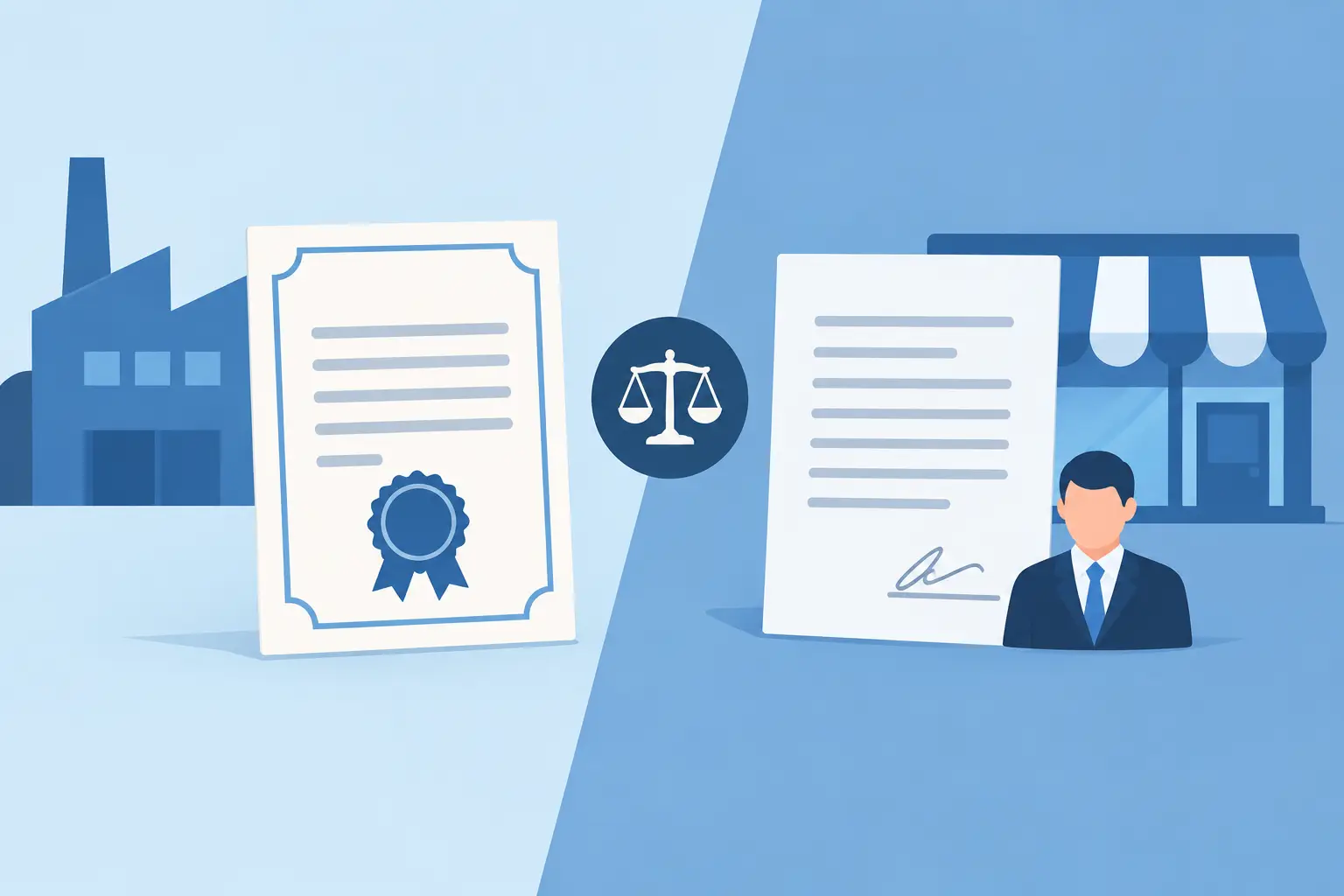
A registration appointment can fail over one seemingly small detail: presenting a dealer-issued statement when the authority requires an official document from the vehicle manufacturer. In the manufacturer certificate versus dealer declaration decision, the document’s issuer, purpose, and connection to EU type approval determine whether it will move your registration forward or send you back for more paperwork.
For imported vehicles, a document may look official, include a VIN, and carry dealership letterhead, yet still not meet the legal requirement for registration. The right choice depends on the vehicle, its approval status, the destination country, and the exact request from the registration authority.
What Is a Manufacturer Certificate?
A manufacturer certificate is a document issued by the vehicle manufacturer or by an authorized entity acting under the manufacturer’s approval process. Its value comes from the source: it is based on OEM production and homologation records, not a dealer’s interpretation of those records.
For European registration, the most relevant manufacturer document is usually the Certificate of Conformity, commonly called a COC. An official EU COC confirms that a specific vehicle was built in conformity with an approved EU vehicle type. It normally identifies the manufacturer, vehicle identification number, type approval number, model and variant information, technical specifications, emissions data, and other registration-relevant details.
A COC is not merely a technical data sheet. It is the manufacturer’s formal conformity document for a vehicle covered by EU whole-vehicle type approval. Registration offices use it because it gives them a reliable, standardized basis for entering vehicle data and confirming compliance.
Not every manufacturer-issued document is a COC. Depending on the brand and vehicle history, an OEM may issue a technical confirmation, a duplicate document, a certificate of data, or a compliance statement. These documents can be useful, but they are not automatically interchangeable with a COC. The document title and the authority’s requirements matter.
What Is a Dealer Declaration?
A dealer declaration is a statement issued by a dealership, distributor, seller, or other commercial representative. It may confirm facts such as the vehicle’s sale date, mileage, equipment, country of delivery, VIN, or that the dealer believes the vehicle meets certain specifications.
Dealers often have access to manufacturer systems and may provide accurate information. However, a dealership is generally not the vehicle manufacturer, and its declaration is usually not the formal proof of EU type conformity required for cross-border registration.
This distinction is especially relevant when a buyer receives a letter stating that a car “complies with European standards.” Unless the letter is an official manufacturer conformity document and the registration office confirms it is acceptable, that wording alone may not be enough. A dealer cannot create EU type approval for a vehicle that was not built and approved under it.
Manufacturer Certificate Versus Dealer Declaration: The Core Difference
The practical difference is authority. A manufacturer certificate is tied to the OEM’s homologation and production records. A dealer declaration is tied to the dealer’s commercial relationship with the vehicle and the information available to that dealer.
| Question | Manufacturer certificate or COC | Dealer declaration | |—|—|—| | Who issues it? | The manufacturer or authorized OEM channel | A dealer, distributor, or seller | | What does it prove? | Official vehicle conformity or OEM-recorded technical data | Dealer-confirmed facts or statements | | Is it commonly accepted for EU registration? | Yes, when it is the correct official document for the vehicle | Sometimes as supporting paperwork, rarely as a COC replacement | | Does it establish EU type approval? | It can document existing approval | No | | Is it suitable for a vehicle without EU approval? | Only if the manufacturer can issue applicable documentation | No, not on its own |
A dealer declaration can still have a valid role. It may help clarify a missing sale record, identify equipment, support a tax or ownership file, or provide information requested by an insurer. The problem begins when it is ordered or submitted as a substitute for manufacturer-issued conformity evidence.
Which Document Will the Registration Authority Accept?
The only reliable answer comes from the authority that will register the vehicle. Requirements vary by country and sometimes by vehicle category, age, fuel type, and origin. A passenger car moving between two EU countries may follow a relatively straightforward COC-based process, while a motorcycle, caravan, converted van, or commercial vehicle may require additional evidence.
When an official COC is usually the right choice
An official COC is normally the preferred document when the vehicle was originally manufactured for the European market and has a valid EU type approval. This commonly applies to many cars, motorcycles, caravans, and light commercial vehicles first supplied in an EU or EEA market.
If the original COC is lost, damaged, or was never passed to the current owner, a replacement issued through the manufacturer’s approved process is often the cleanest solution. It provides the standardized data registration offices expect and reduces the risk of manual technical verification.
COC-Express.eu helps vehicle owners and professionals obtain authentic OEM-issued COCs for eligible brands and vehicles, providing a direct route to the manufacturer document rather than relying on informal declarations.
When a dealer declaration may be accepted
A dealer declaration may be accepted when the registration authority asks for supplemental information rather than proof of type conformity. For example, it may support a request for confirmation of factory equipment, a date of first delivery, or an administrative correction.
It can also be useful where the dealer is an official national distributor and the authority specifically requests a distributor letter. Even then, ask the authority whether the letter must contain particular details, such as the VIN, approval number, stamp, signature, and contact information. Never assume a generic dealer letter will satisfy a legal registration requirement.
When neither document solves the issue
A vehicle imported from the United States, Canada, Japan, or another non-EU market may not have EU whole-vehicle type approval. In that case, an EU COC may not exist, even if the model is also sold in Europe. The imported vehicle’s exact VIN and production specification determine eligibility.
A dealer declaration cannot fix this gap. The vehicle may instead need an individual approval, technical inspection, conversion work, emissions testing, or a national compliance procedure. This is why checking eligibility before paying for a document is essential.
How to Avoid Ordering the Wrong Vehicle Document
Start with the exact wording of the registration authority’s request. “Proof of conformity,” “COC,” “technical data,” and “manufacturer confirmation” may sound similar, but they can mean different things in practice. If the authority asks specifically for a Certificate of Conformity, a dealer declaration is a high-risk substitute.
Next, verify the vehicle’s VIN, first registration country, model year, and market of original supply. A European-market vehicle with EU type approval is the strongest candidate for an official replacement COC. A gray import or heavily modified vehicle needs more careful review.
Finally, separate original-document issues from eligibility issues. If the vehicle was approved for the EU market but the document is missing, an OEM-issued replacement may solve the problem quickly. If the vehicle was never approved under the relevant EU type approval, no dealer letter and no replacement COC request will change that status.
Details to Confirm Before You Submit Anything
Before scheduling registration, confirm these points with the authority or your registration agent:
- Whether an original, duplicate, or digital manufacturer document is accepted.
- Whether the document must be issued for the exact VIN, not only the model range.
- Whether translations, legalization, or certified copies are required.
- Whether modifications such as tow hitches, camper conversions, suspension changes, or engine swaps require separate approval.
Keep the purchase invoice, foreign registration documents, identity documents, and any customs or tax paperwork ready as well. A COC addresses conformity, but it does not replace every document needed for ownership transfer, import processing, or local registration.
The fastest route is rarely the document that is easiest to obtain. It is the document the authority can accept without asking for more evidence. Confirm the requirement first, then secure the manufacturer-issued record that matches the vehicle and the registration process.